
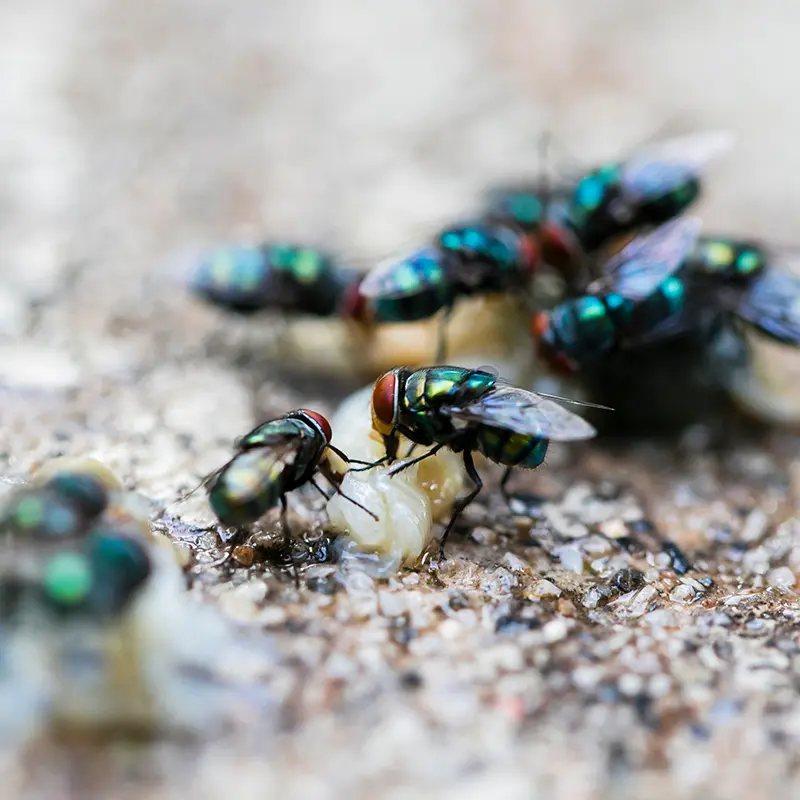
Fly Control in Canterbury
Flies causing problems in Canterbury? We provide professional fly control for homes and businesses. Local to historic city centre. BPCA member company.
Fly treatment at a glance
| Pest treated | Flies (Musca domestica (house fly) / Calliphora vomitoria (bluebottle)) |
|---|---|
| Peak season | Summer |
| How long it takes | Fly numbers fall once the breeding source is eliminated. Commercial fly management is an ongoing service with regular unit maintenance. |
| Visits usually needed | 4-stage process, carried out over one or more visits depending on how far the problem has spread |
| How urgent | Book within a few days. It will spread if left, but it is not an emergency. |
| When you call | Flies in a food business are the detail to give first when you call, because they carry the most risk. |
| Area covered | Canterbury |
| Safety | Carried out by a technician from a BPCA member company, fully insured. We tell you which areas to keep children and pets out of, and for how long, before we start. |
| What it costs | The price depends on the pest, the size of the property and how far the infestation has spread. No call-out fee. Free, no-obligation quote before any treatment starts: call 07400 372204. |
GEM Services treats flies in Canterbury for homes and businesses, working from its base in Ashford. We are a BPCA member company, and every job starts with a free, no-obligation quote before any treatment starts. Canterbury is a historic cathedral city on the River Stour in east Kent.
Signs of flies in Canterbury
Knowing what to look for is the first step to dealing with a fly problem. In Canterbury, medieval and Tudor buildings in the city centre and Victorian terraces near the centre are common, and each has different vulnerabilities. Here are the key signs to watch for:
Large numbers of flies indoors
A few flies are normal in summer. Persistently large numbers, especially concentrated in one room, suggest a breeding source nearby: rotting food, a dead animal, or a drain issue.
Maggots in bins or around food waste
White, legless larvae (maggots) in your bin, compost, or around pet bowls confirm flies are breeding on your property.
Clusters of flies at windows
Flies buzzing at windows are often trying to exit. If you find the same thing every morning, they may be breeding inside the building: in a wall cavity, loft space, or hidden waste.
Dark spots on walls and light fittings
Fly specks (regurgitated food and droppings) leave dark spots on walls, ceilings, and light fixtures. Heavy spotting indicates a sustained fly presence.
Why fly problems occur in Canterbury
Flies are attracted to food, waste, and decomposing matter. They taste with their feet, landing on surfaces to sample food. They vomit digestive fluids onto food before feeding, which is how they spread bacteria. House flies stay close to food sources and breed in warm, moist organic matter.
The combination of historic buildings with aging fabric, a high density of restaurants and takeaways serving the student population, and the River Stour makes Canterbury a persistent hotspot for rats and mice. Student properties often have fast tenant turnover, allowing problems to go unreported. Local features like historic city centre and River Stour influence where flies are most active in the area.
Seasonal pattern in Canterbury
Fly populations peak from June to September when warm temperatures accelerate breeding. A single pair of house flies could theoretically produce millions of descendants in one summer if unchecked.
How we treat fly problems in Canterbury
Source identification
The priority is finding and eliminating the breeding source. We inspect bins, drains, loft spaces, and potential hidden sources like a dead animal in a wall cavity or under floorboards.
Source removal
We remove or address the breeding material. This might mean cleaning a fouled drain, removing a dead bird from a chimney, or advising on waste management improvements.
Knock-down treatment
For heavy infestations, we apply a targeted insecticidal spray to reduce the existing fly population. This reduces the number of flies while the breeding source is dealt with.
Prevention measures
We install electric fly units (EFKs) for commercial premises and advise on proofing, drainage maintenance, and waste management to prevent recurrence.
Fly numbers fall once the breeding source is eliminated. Commercial fly management is an ongoing service with regular unit maintenance.
Health and safety risks in Canterbury
- ⚠Salmonella, E. coli, and other bacterial contamination of food
- ⚠Dysentery and gastroenteritis from fly-borne pathogens
- ⚠Flies carry bacteria on their feet and spread it by vomiting digestive fluids onto food before feeding
How to keep flies out of your Canterbury property
- ✓Keep bins sealed with tight-fitting lids and clean them regularly in summer.
- ✓Clear up pet food bowls promptly. Do not leave food sitting out.
- ✓Fit fly screens to kitchen and dining area windows during summer months.
- ✓Check drains are flowing freely. Blocked or slow drains are a common breeding site.
- ✓Dispose of food waste frequently and do not let it accumulate indoors.
Book fly control in Canterbury
We cover Canterbury from our base in Ashford. No call-out fee, and a free, no-obligation quote before any treatment starts.
We operate across Canterbury and the surrounding Kent area.
Beyond fly services, we handle all types of pest control locally. Visit our Pest Control in Canterbury page for the full range.
Call us today on 07400 372204 for a free, no-obligation quote.
Flies in Canterbury: Common Questions
What should I tell you when I call about fly problems in Canterbury?+
We cover Canterbury, Kent. Flies in a food business are the detail to give first when you call, because they carry the most risk.
Why are there suddenly so many flies in my house?+
A sudden fly invasion usually means there is a breeding source nearby. Common causes are a dead animal in a wall cavity or chimney, a blocked drain, or a bin that needs cleaning. We can identify and eliminate the source.
What is the difference between house flies and cluster flies?+
House flies breed in food waste and are active in summer. Cluster flies are a different species that hibernate in buildings over winter. They enter loft spaces in autumn and emerge on warm days, sometimes in large numbers.
Do electric fly killers work?+
Yes. Professional electric fly units are very effective in commercial kitchens and food areas. They attract and kill flies continuously without chemicals. We supply and maintain commercial-grade units.
How much does fly treatment cost in Canterbury?+
Costs depend on the severity of the problem and property size. Properties in Canterbury are typically medieval and Tudor buildings in the city centre, which can affect treatment scope. Contact us for a free, no-obligation quote.
Why are flies common in Canterbury?+
The combination of historic buildings with aging fabric, a high density of restaurants and takeaways serving the student population, and the River Stour makes Canterbury a persistent hotspot for rats and mice. Student properties often have fast tenant turnover, allowing problems to go unreported. Flies are attracted to food, waste, and decomposing matter.
Are your fly treatments safe for pets and children?+
Treatments are carried out by a technician from a BPCA member company, using professional products applied to label. Before we start we tell you which areas to keep children and pets out of, and for how long, and we leave written aftercare instructions.