
Mole Control in Kent
Moles in a Kent property are treated by GEM Services with a 4-stage process: activity mapping, professional trapping, checking and removal, lawn advice. How long it takes depends on how many moles are active and how large the tunnel network is. Treatment is carried out by a technician from a BPCA member company, with a free, no-obligation quote before any treatment starts, and callouts peak in spring and autumn.
What you are dealing with: moles
Species we most often treat in Kent: Talpa europaea
Moles are solitary animals that live almost entirely underground. They breed once per year in spring, producing a small litter. Young moles leave the nest in early summer and must find their own territory. This dispersal period in early summer often causes a spike in new mole activity across lawns and fields.
A single mole digs an extensive tunnel network, moving up to 20 metres of soil per day. They patrol their tunnels regularly, eating any worms and grubs that fall in. Moles are active throughout the year and do not hibernate. Most of the damage you see is caused by just one or two moles.
Moles eat earthworms, leather jackets, and soil-dwelling grubs. They need to eat roughly half their body weight each day. They prefer moist, well-drained soil that supports a good worm population, which is exactly the kind of soil found in well-maintained lawns and gardens.
Where we usually find moles on a property
- ✓Under a large molehill (the fortress) usually near a hedge or fence line
- ✓In well-drained soil with good worm populations
- ✓Lawns, garden borders, and field margins
- ✓Not in waterlogged or very sandy soil
Mole treatment at a glance
| Pest treated | Moles (Talpa europaea) |
|---|---|
| Peak season | Spring and Autumn |
| How long it takes | How long it takes depends on how many moles are active and how large the tunnel network is. Traps are checked until the activity stops. |
| Visits usually needed | 4-stage process, carried out over one or more visits depending on how far the problem has spread |
| How urgent | Not urgent. Worth booking alongside other work rather than on its own. |
| When you call | Mole problems are not urgent, but acting while the tunnel network is still small keeps the treatment simpler. |
| Area covered | Kent and East Sussex, from our base in Ashford |
| Safety | Carried out by a technician from a BPCA member company, fully insured. We tell you which areas to keep children and pets out of, and for how long, before we start. |
| What it costs | The price depends on the pest, the size of the property and how far the infestation has spread. No call-out fee. Free, no-obligation quote before any treatment starts: call 07400 372204. |
Signs you have moles
Catching the problem early decides how much of it there is to treat. These are what we look for on arrival, and what is worth checking before you call.
Fresh molehills on the lawn
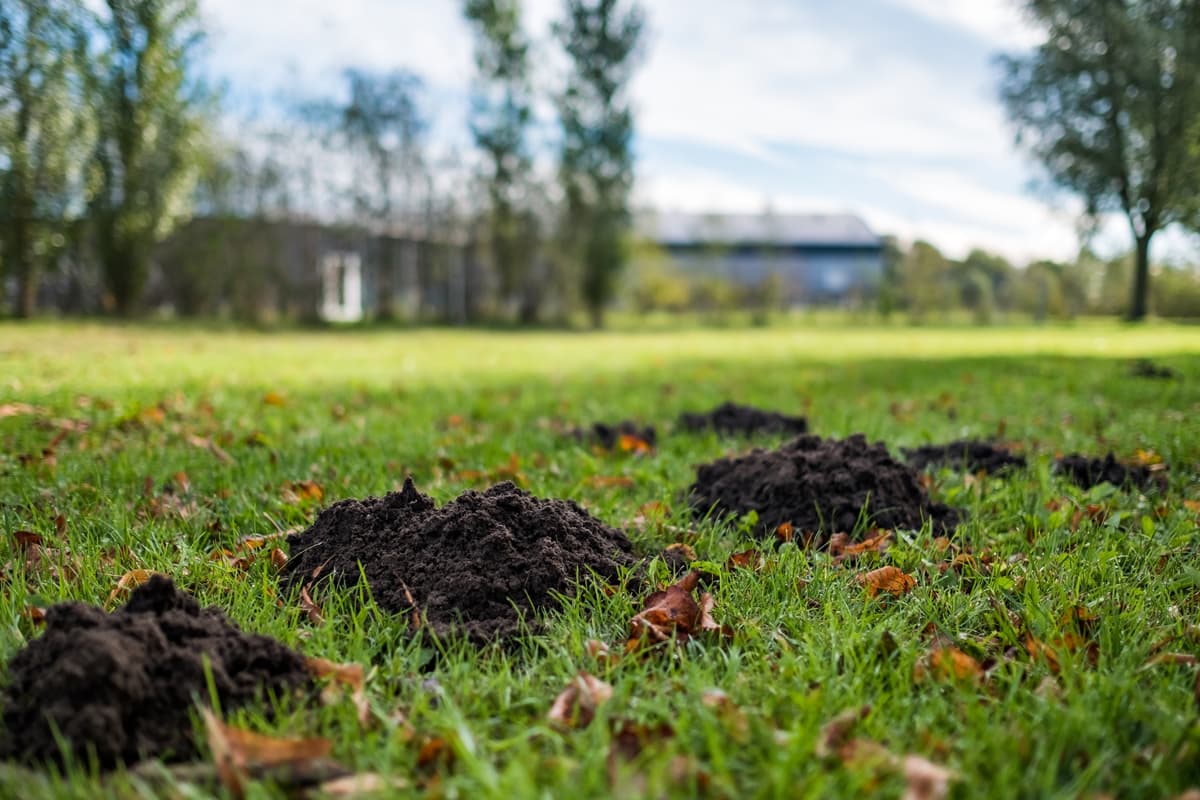
Molehills are mounds of loose, finely crumbled soil pushed up from below. Fresh hills appear overnight and the soil will be damp and dark. A single mole can produce several hills per day.
Raised ridges of soil across the lawn
Shallow surface tunnels push up visible ridges of turf. These are feeding tunnels and may only be used once, but they damage grass roots along their length.
Soft or sinking patches in the lawn
Walking over mole tunnels can feel spongy underfoot. Deeper tunnels may collapse under foot traffic, leaving uneven dips across the lawn.
Disturbed flower beds or vegetable patches
Moles tunnelling through garden beds uproot plants and damage root systems. Rows of bulbs can be displaced from below.
How we treat moles, step by step
Every job follows this sequence. What changes between properties is how long each stage takes, not the order.
- 1
Activity mapping
We identify which tunnels are actively in use by lightly pressing them down and checking which are repaired overnight. This tells us exactly where the mole is working.
- 2
Professional trapping
We set professional-grade mole traps in active runs. Trapping is the most humane and effective method: it targets the specific mole causing the damage without affecting other wildlife.
- 3
Checking and removal
We return to check the traps. Most mole problems are resolved by catching one or two moles.
- 4
Lawn advice
After trapping, we can flatten existing molehills and advise on lawn repair. We also explain what to watch for if new mole activity appears in future.
How long it takesHow long it takes depends on how many moles are active and how large the tunnel network is. Traps are checked until the activity stops.
What moles cost you if they are left
Moles ruin the appearance of lawns and garden beds. Tunnelling damages grass roots, displaces plants, and creates an uneven surface that is difficult to mow and can be a trip hazard. For properties with well-kept gardens, the visual damage is significant.
Moles are a serious problem for sports pitches, golf courses, and bowling greens where surface quality is critical. Agricultural land suffers from contaminated silage when soil from molehills is mixed into grass crops. Commercial grounds and parks lose their visual appeal.
Health risks
- ⚠Moles themselves pose minimal direct health risk
- ⚠Trip hazard from uneven ground and collapsed tunnels
- ⚠Soil contamination of silage in agricultural settings
Damage to the property
- ⚠Ruined lawns and garden beds
- ⚠Damaged plant root systems
- ⚠Uneven ground surfaces
- ⚠Contaminated agricultural silage
- ⚠Undermined paths, patios, and driveways in severe cases
When mole problems peak in Kent
Mole activity is most visible in spring when males extend their tunnel networks to find mates, and in autumn when worms move deeper and moles dig new tunnels to follow them. Wet weather also drives moles to push up more soil.
Keeping moles out after treatment
Treatment clears what is there now. These are what stop it coming back, and they are worth doing whether or not you use us.
- ✓There is no reliable way to prevent moles entirely: they go where the worms are.
- ✓Reducing excessive watering can lower worm populations near the surface, making the area less attractive.
- ✓Physical barriers (wire mesh buried vertically around small areas) can protect specific garden beds.
- ✓Sonic deterrent devices have limited evidence of effectiveness and often just move the problem.
- ✓Regular monitoring and early trapping when the first hills appear prevents tunnel networks from expanding.
When you do not need us
A single mole sighting outdoors, away from the building and with none of the signs above, is usually not an infestation and does not need a treatment. Work through the prevention points first and see whether the activity continues.
Call us when the signs are repeating rather than one-off, when you find them indoors, or when you have tried proofing and the activity has continued.
We also do not carry out structural repairs. We seal and proof the entry points we find, but where the fabric of the building needs rebuilding, that is a builder’s job and we will say so.
We do not carry out deep cleans, and we do not deal with foxes. We do not treat Asian hornets either: the government deals with those, so report a suspected sighting through the Asian Hornet Watch app.
Mole Control across Kent
We treat mole control throughout Kent, for homes and businesses. There are local pages for Ashford and Canterbury.
View All Coverage Areas →Moles treatment: common questions
How many moles are causing the damage?
Usually just one or two. Moles are solitary and territorial. A single mole can produce dozens of hills across a large lawn. We identify and trap the specific moles responsible.
Do mole deterrents work?
Sonic devices, mothballs, and home remedies have very little evidence behind them. In our experience they either do nothing or temporarily move the mole to another part of the garden. Professional trapping is the only reliable solution.
Is mole trapping humane?
Yes. Professional mole traps are designed for a quick, clean catch. It is the method recommended by pest control industry bodies and is far more humane than poisoning, which is now restricted.
Can moles damage my foundations?
Mole tunnels run shallow and rarely threaten building foundations. However, extensive tunnelling can undermine paths, patios, and driveways over time.
Will more moles move in after trapping?
It is possible. Vacant mole territories can attract new moles, especially during spring dispersal. If new activity appears, early re-trapping prevents the problem from re-establishing.
Book mole control in Kent
Moles problems do not resolve on their own, and the longer an infestation runs the more of the property it reaches.
Mole problems are not urgent, but acting while the tunnel network is still small keeps the treatment simpler.
How long it takes depends on how many moles are active and how large the tunnel network is. Traps are checked until the activity stops.
We cover Kent and East Sussex from our base in Ashford. Treatments are carried out by a technician from a BPCA member company, and we are fully insured.
The next step is a phone call.
Tell us what you have seen and where. We will tell you what treating it involves, and the quote is free, with no obligation, before any treatment starts.
Call 07400 372204Cannot talk right now? Send us the details instead and we will call you back.
Not sure it needs treatment yet? When to call a pest controller and when to wait