
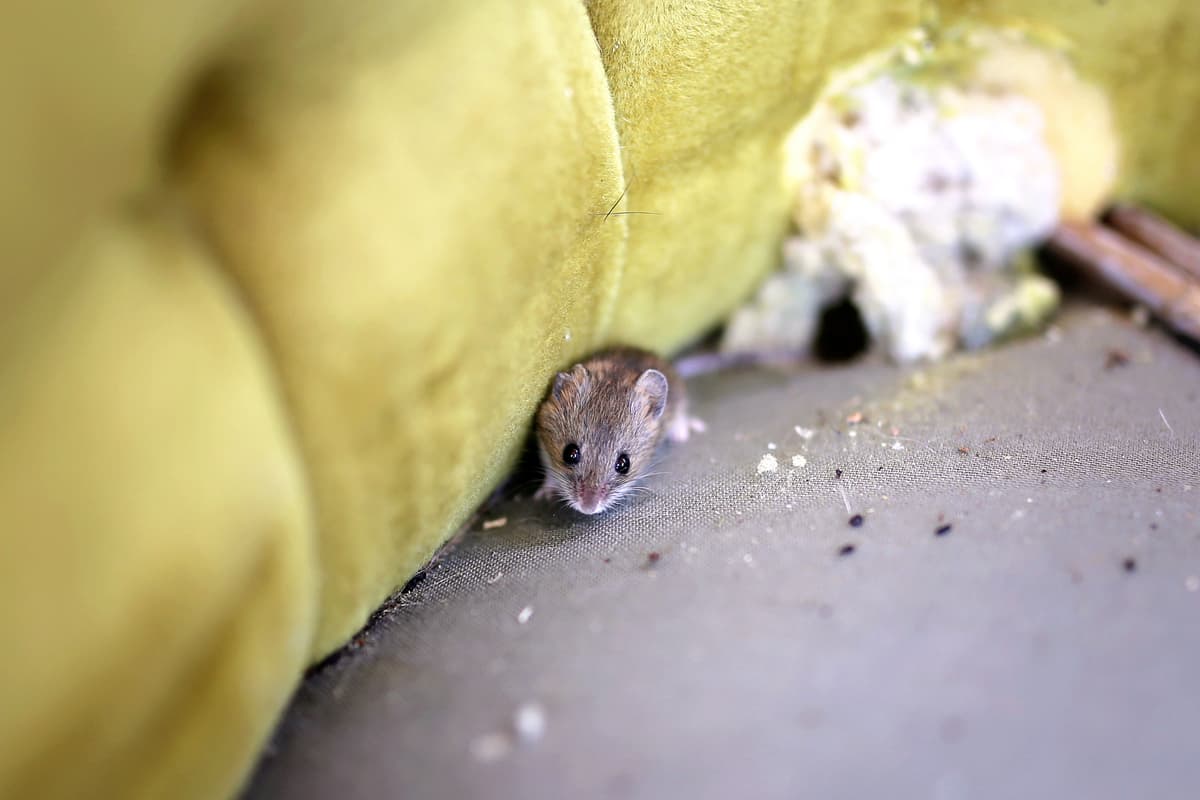
Mouse Control in Kent
Mice in a Kent property are treated by GEM Services with a 4-stage process: thorough property inspection, baiting and trapping, follow-up monitoring, entry point proofing. How long it takes depends on how far the mice have spread and how many entry points there are. Treatment is carried out by a technician from a BPCA member company, with a free, no-obligation quote before any treatment starts, and callouts peak in autumn and winter.
What you are dealing with: mice
Species we most often treat in Kent: Mus musculus (house mouse)
The house mouse breeds rapidly, producing many litters a year, and pups reach breeding age within weeks. A single pair can build a substantial population inside one season if nothing is done.
Unlike rats, mice are curious and will investigate new objects quickly, making them easier to trap. They are excellent climbers and can scale rough vertical surfaces, walk along cables, and jump well for their size. Mice keep to a small home range around their nest, which is why activity clusters in one part of a property.
Mice prefer cereals and grains but will eat almost anything. They nibble small amounts from many sources rather than feeding in one spot. They need very little water and can survive on moisture in food alone. They favour warm, enclosed spaces close to food.
Where we usually find mice on a property
- ✓Behind kitchen appliances (ovens, fridges, washing machines)
- ✓Inside wall cavities
- ✓In loft insulation
- ✓Under-stair cupboards
- ✓Behind bath panels
- ✓Inside stored boxes and clutter
Mouse treatment at a glance
| Pest treated | Mice (Mus musculus (house mouse)) |
|---|---|
| Peak season | Autumn and Winter |
| How long it takes | How long it takes depends on how far the mice have spread and how many entry points there are. Proofing the entry points is part of every treatment. |
| Visits usually needed | 4-stage process, carried out over one or more visits depending on how far the problem has spread |
| How urgent | Book within a few days. It will spread if left, but it is not an emergency. |
| When you call | Mice in a kitchen or food area are the detail to give first when you call, because it decides how the visit is planned. |
| Area covered | Kent and East Sussex, from our base in Ashford |
| Safety | Carried out by a technician from a BPCA member company, fully insured. We tell you which areas to keep children and pets out of, and for how long, before we start. |
| What it costs | The price depends on the pest, the size of the property and how far the infestation has spread. No call-out fee. Free, no-obligation quote before any treatment starts: call 07400 372204. |
Signs you have mice
Catching the problem early decides how much of it there is to treat. These are what we look for on arrival, and what is worth checking before you call.
Small dark droppings
Mouse droppings are 3-6mm long, dark, and spindle-shaped with pointed ends. You will find them scattered along skirting boards, in cupboards, and behind kitchen appliances.
Scratching or rustling sounds
Mice are most active at night. You may hear light scratching in walls, under floors, or in the loft. The sound is quieter and higher-pitched than rat activity.
Shredded materials in hidden corners
Mice tear paper, cardboard, loft insulation, and fabric to build nests. Finding shredded material behind furniture or in the back of cupboards is a strong indicator.
Small gnaw marks on food packaging
Look for small, irregular teeth marks on cereal boxes, biscuit packets, and plastic food bags. Mice have smaller teeth than rats, leaving narrower marks.
Musty, ammonia-like smell
A mouse-inhabited area develops a characteristic stale, musky odour from their urine. This smell is strongest in enclosed spaces like cupboards and under-stair areas.
How we treat mice, step by step
Every job follows this sequence. What changes between properties is how long each stage takes, not the order.
- 1
Thorough property inspection
We check the entire property to assess activity levels, locate nesting sites, and identify all entry points. Mice leave UV-visible urine trails that help us map their routes.
- 2
Baiting and trapping
We deploy tamper-resistant bait stations and snap traps in targeted locations along mouse runs. We choose the method best suited to your property, for example traps rather than poison where pets or children are present.
- 3
Follow-up monitoring
We return to check traps, assess bait take, and confirm activity is reducing. Mouse infestations typically require 1-2 follow-up visits.
- 4
Entry point proofing
We seal gaps with wire wool, metal plates, or cement. Any hole larger than 6mm is a potential mouse entry point. We identify and close them all.
How long it takesHow long it takes depends on how far the mice have spread and how many entry points there are. Proofing the entry points is part of every treatment.
What mice cost you if they are left
Mice contaminate kitchen surfaces and food with droppings and urine. They gnaw electrical cables, increasing fire risk. Their nesting in loft insulation reduces its effectiveness. The constant night-time noise causes sleep disruption and stress.
Any evidence of mice in a food business can trigger enforcement action from Environmental Health. Contaminated stock must be destroyed. Retail and office environments suffer reputation damage when mice are spotted by customers or staff.
Health risks
- ⚠Salmonella and E. coli from droppings on food surfaces
- ⚠Hantavirus (rare in UK)
- ⚠Allergic reactions to mouse dander and droppings
- ⚠Lymphocytic choriomeningitis virus (LCMV)
Damage to the property
- ⚠Gnawed electrical wiring
- ⚠Damaged loft insulation
- ⚠Contaminated stored food
- ⚠Chewed furniture, books, and clothing
- ⚠Soiled areas from urine trails
When mouse problems peak in Kent
Mice move indoors from October as temperatures drop. They can enter through gaps as small as 6mm, the width of a pencil. Indoor populations remain active through winter and breed year-round in heated buildings.
Keeping mice out after treatment
Treatment clears what is there now. These are what stop it coming back, and they are worth doing whether or not you use us.
- ✓Seal any gap larger than 6mm (pencil width) around pipes, cables, and door frames.
- ✓Store all food in glass, metal, or heavy plastic containers with tight lids.
- ✓Clear clutter from under stairs, in garages, and in loft spaces. Mice nest in undisturbed areas.
- ✓Keep kitchen surfaces clean and sweep up crumbs daily.
- ✓Check the seals around your garage door and any utility entry points. These are common weak spots.
When you do not need us
A single mouse sighting outdoors, away from the building and with none of the signs above, is usually not an infestation and does not need a treatment. Work through the prevention points first and see whether the activity continues.
Call us when the signs are repeating rather than one-off, when you find them indoors, or when you have tried proofing and the activity has continued.
We also do not carry out structural repairs. We seal and proof the entry points we find, but where the fabric of the building needs rebuilding, that is a builder’s job and we will say so.
We do not carry out deep cleans, and we do not deal with foxes. We do not treat Asian hornets either: the government deals with those, so report a suspected sighting through the Asian Hornet Watch app.
Mouse Control across Kent
We provide mouse control across Kent and East Sussex. Find your local Kent area below.
Mice treatment: common questions
How small a gap can a mouse fit through?
A mouse can squeeze through a gap as small as 6mm, about the width of a pencil. This is why proofing is essential. We check every potential entry point and seal them.
Should I use poison or traps?
It depends on your situation. In homes with pets or small children, we often use snap traps. In loft spaces and commercial premises, tamper-resistant bait stations are usually more effective. We advise the best approach for your property.
I only saw one mouse. Is it an infestation?
Possibly. Mice breed extremely fast and are rarely alone. If you have seen one, there are very likely more nearby. Early treatment prevents the problem from escalating.
How do mice get into my loft?
Mice climb rough walls, squeeze through gaps around roof tiles, and follow pipework and cables up through the building. Once in the loft, warm insulation provides an ideal nesting site.
Will the mice come back after treatment?
Not if entry points are sealed. Proofing is the most important part of mouse control: it stops new mice entering even if populations build up outside.
Are mouse droppings a health risk?
Yes. Mouse droppings carry bacteria including salmonella and E. coli. Avoid sweeping them up. Spray with disinfectant first, then wipe with disposable cloths and gloves.
Book mouse control in Kent
Mice problems do not resolve on their own, and the longer an infestation runs the more of the property it reaches.
Mice in a kitchen or food area are the detail to give first when you call, because it decides how the visit is planned.
Same-day visits are sometimes possible, depending on the diary.
How long it takes depends on how far the mice have spread and how many entry points there are. Proofing the entry points is part of every treatment.
We cover Kent and East Sussex from our base in Ashford. Treatments are carried out by a technician from a BPCA member company, and we are fully insured.
The next step is a phone call.
Tell us what you have seen and where. We will tell you what treating it involves, and the quote is free, with no obligation, before any treatment starts.
Call 07400 372204Cannot talk right now? Send us the details instead and we will call you back.
Not sure it needs treatment yet? When to call a pest controller and when to wait